Eterra: The Key Predecessor to Vaporbrothers
Late in 1998 the "Vapor Brothers" in Los Angeles got their start by experimenting with two vaporizers, one the globe-style, likely a BC Vaporizer. The other, and arguably more influential, was the "Eterra," a hand-held vaporizer that became the archetype of what we now call a “log vape.” Recognizing the effectiveness of heated air passing through herbs, VB’s founders tore apart the globe vaporizer and remade it as a convection vaporizer which became Vaporbrothers' first prototype. This history includes all of what we know about Eterra and its inventor Bob Burruss.
We’ve just discovered on fuckcombustion.com that Bob passed away. Here is all we know about him and have collected from FC and our own records. (See FC thread here)
The Inventor: Bob Burruss
Bob Burruss was an engineer under contract with the U.S. EPA in the 1970s. While studying toxic compounds from incomplete combustion, he visited a Monsanto incinerator designed to turn trash into fuel gas using heated air. That visit gave him the idea: herbs could be vaporized the same way - using air heated just enough to release volatiles, without burning the plant.
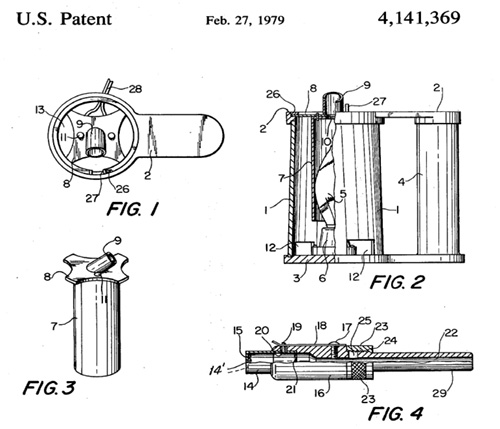
His first prototype was built from lab glass and a 1,000-watt toaster element. It worked briefly before melting. Two years later, he made a 100-watt model using a brake fluid can and a light bulb. That version led to his patent: U.S. 4,141,369, filed in 1977 and granted in 1979. It was an early patent describing heated-air noncombustion inhalation.
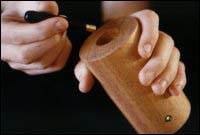
From there, Bob created a series of low-wattage convection units. First came the Flash Evaporator, a home-built lab-style vaporizer using about 10 watts. Then came the Eterra, a smaller version in a wood housing. The Eterra Tulip came later with a ceramic tulip-shaped heater and deeper stem socket. He also developed the Pneuma, a handheld convection vape, and reportedly one of the first battery-powered vaporizers. He made a heater that attached to a soldering gun and sold various custom designs over the years.
Bob's vaporizers were sold under the name Solaria, based in Berkeley, California. Buyers ordered by mail to PO Boxes 3084 and 4611. Each unit came with a strong disclaimer - legal use only, and buyers had to confirm they were 18 and using the product under advice from someone knowledgeable in herbal use. He avoided cannabis references due to federal law, even though people in the community knew what the devices were for.
Bob’s devices ran at low wattage, used no plastics in the vapor path, and were designed for 24/7 operation. He was known for his engineering focus and his caution about health and safety. Lightwell.net hosted his educational materials on the dangers of combustion and the benefits of vaporizing.
According to posts on the FuckCombustion forum, community members credit Bob Burruss’s Eterra with influencing later ‘log’ vaporizers such as Purple-Days and E-Nano. One user said they bought a Flash Evaporator from him in person in 1994 and stayed in touch as Bob continued developing models from his home workshop.
The founder of Vaporbrothers posted on FC that the Eterra was one of two vaporizers that inspired their design. They disassembled an Eterra and realized how much better vapor tasted when made with convection. That led to the first VB box prototype. Burruss’s work shaped the direction of whip-based vaporizers and the broader shift from combustion to vapor.
See Bob's page for Eterra on the internet archive here: https://web.archive.org/web/20080309032120/http://www.lightwell.net/classic.html
The VaporDoc Fork
As an interesting side note, while Vaporbrothers wasn't able to meet Bob or give him the recognition he deserves, Bob did help a company copy the Vaporbrothers design. If there's anybody deserving of using the technology it's Bob. Here is a brief story about Vapor Doc:
In the early 2000s, Roger Moussa of "VaporDoc" attempted to become Vaporbrothers distributor in Berkeley. We got along very well with him and his brother AJ, but sadly had a falling out when we needed extra weeks to build the first few hundred units for them. They made a request that was strange to us- to give them our unit without our name on it. After a few difficulties with Roger and a falling out, he just went ahead and made his own copy of the Vaporbrothers box. He expressed that he originally wanted to make his own vaporizer anyway. A mutual friend named Jason recalls that Burruss was key in helping Roger develop the early VaporDoc design; we haven’t verified those details independently yet. Jason and Bob Burruss originally wanted to call it “VaporCannon”, but Rodger chose “VIA” (Vaporizer Inhalation Appliance..?) instead. When Roger’s brother AJ took over and built the vaporizers he reinstated the VaporCannon name. This offshoot still appears in AJ’s "Vapor Store."
Legacy and Acknowledgment
Bob Burruss passed away according to a memorial thread on the FuckCombustion Forum titled "Bob Burruss has died..." Community members there shared direct memories, including visits to his Berkeley workshop and purchases of early units like the Flash Evaporator.
Devices like Purple Days, Toasty Top, E-Nano, Aromazap and nearly every log-style vaporizer trace back to Bob's designs. In our opinion, all whip-style boxes owe him credit, since Vaporbrothers invented the Whip-style vaporizer type, and the idea of using convection air to extract vapor came from taking apart an Eterra. (Whip™ is a trademark of Vaporbrothers, Inc.)
Bob didn’t seek mainstream fame. He followed a clear idea: heated air, not combustion. He built everything himself, shipped from a PO Box, and stuck to his beliefs even when others took the concept and commercialized his designs.
Rest in peace, Bob. You started something real.
----
Bob's own account of how he began his mission of vaporizing (Copied from his former website)
A Brief History of the Flash Evaporator, Eterra and Other Vapor Projects
In 1975 I (Bob Burruss) shared an office with a cigar smoker, who eventually died of lung cancer. Second-hand smoke was not considered a problem in those days. But I was working then under contract to the U.S. EPA, studying the cancer-causing chemicals produced by incomplete combustion, as in cigarettes, cigars, and in the oxygen-starved combustion of coal and solid waste.
One day, as a part of my job, I visited a new kind of solid-waste incinerator which Monsanto had designed and built for the city of Baltimore. My task was to decide whether to bid on doing an economic analysis of the incinerator's performance.
The special feature of the Monsanto incinerator was that it was designed to burn the solid waste incompletely, thereby producing fuel gases that could be piped to, and used to heat, office buildings in downtown Baltimore.
At some point during my visit to the Monsanto plant I realized that tobacco could probably also be heated without combustion -- in other words, I realized that electrically heated air could be used to evaporate the taste and nicotine into an inhalable airstream without having to use the tobacco itself as the energy source to evaporate the taste and nicotine into an inhalable airstream.
I decided to build a noncombustion tobacco inhaler, market it, and then retire. Instead, I learned about the frustrations, challenges and wonders of hands-on research and development.
The first test model was made from laboratory glassware. It used a 1,000-watt heating element from a toaster and survived long enough to prove the idea, and then it melted down. Two years later I had a 100-watt model, which was built from a light bulb and a brake fluid can. My first patent, 4,141,369, was based on that model, which was called the Health Pipe.
The present Flash Evaporator and Eterra grew from that origin. Each of them uses about 10 watts of power. The Tobacco Master models use about 40 to 50 watts and, in a sort of irony, the smallest one is the size of a pack of cigarettes.